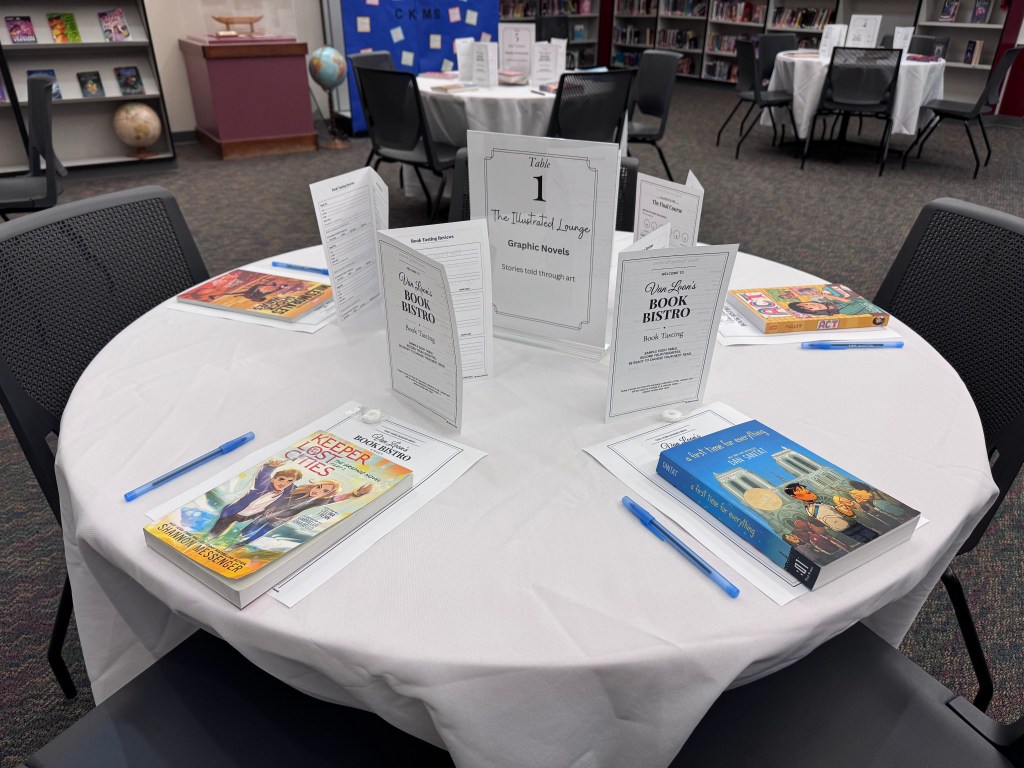
I recently hosted a Book Tasting for ~150 sixth and seventh graders — and 74% of them walked away having identified a book they actually want to read.
That number alone made the entire thing worth it.
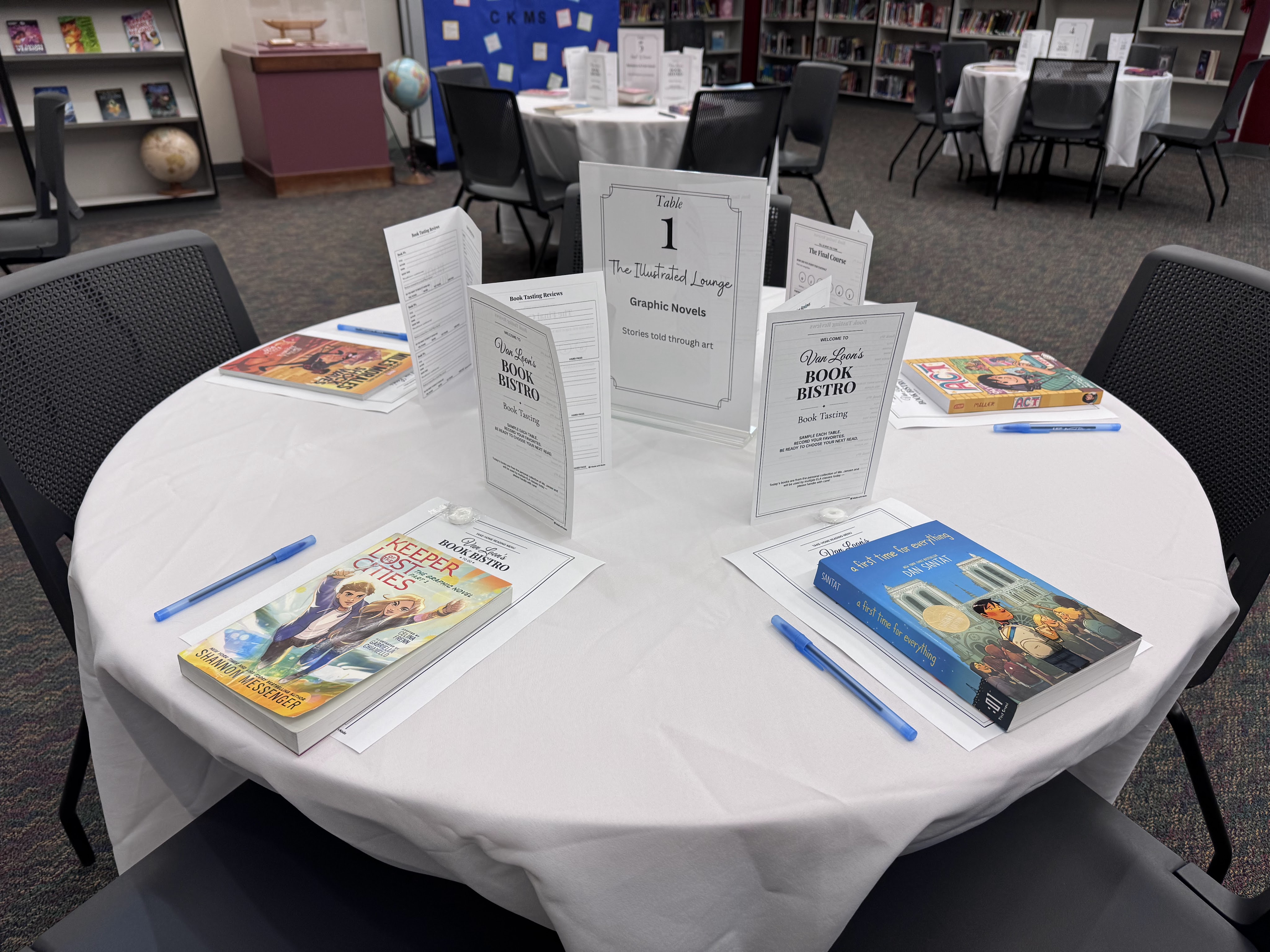
Ever since I stumbled across Book Tastings on Pinterest, I’ve wanted to try one. So when one of the ELA teachers at my son’s middle school said she was open to me hosting one for her five classes, I was ecstatic.
Book & Genre Selection
The best part of prep was choosing the books for the tasting.
The hardest part was limiting myself to eight books per genre.
After a lot of research, I ultimately landed on six genres / table categories:
- Graphic Novels
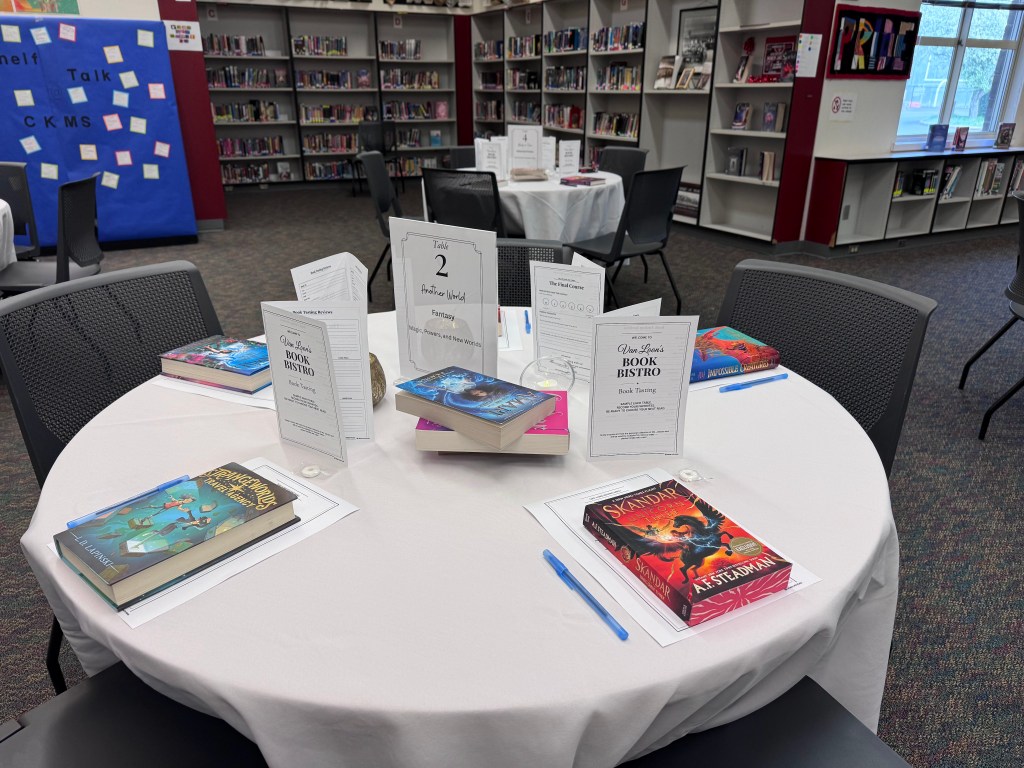
- Fantasy
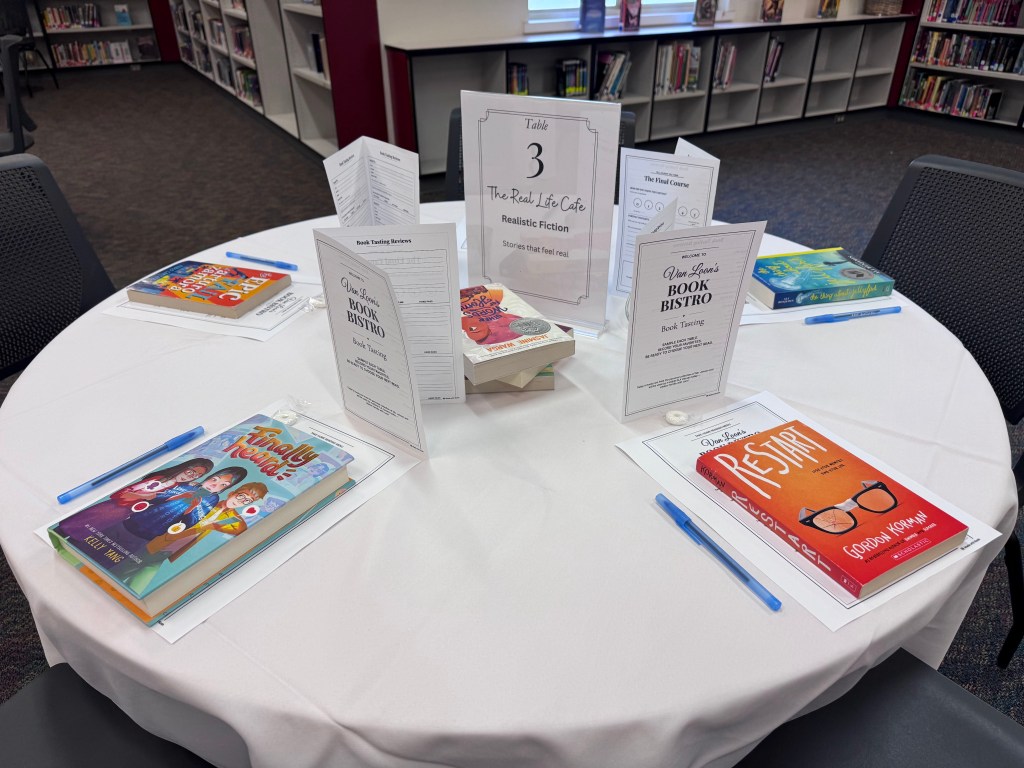
- Realistic Fiction
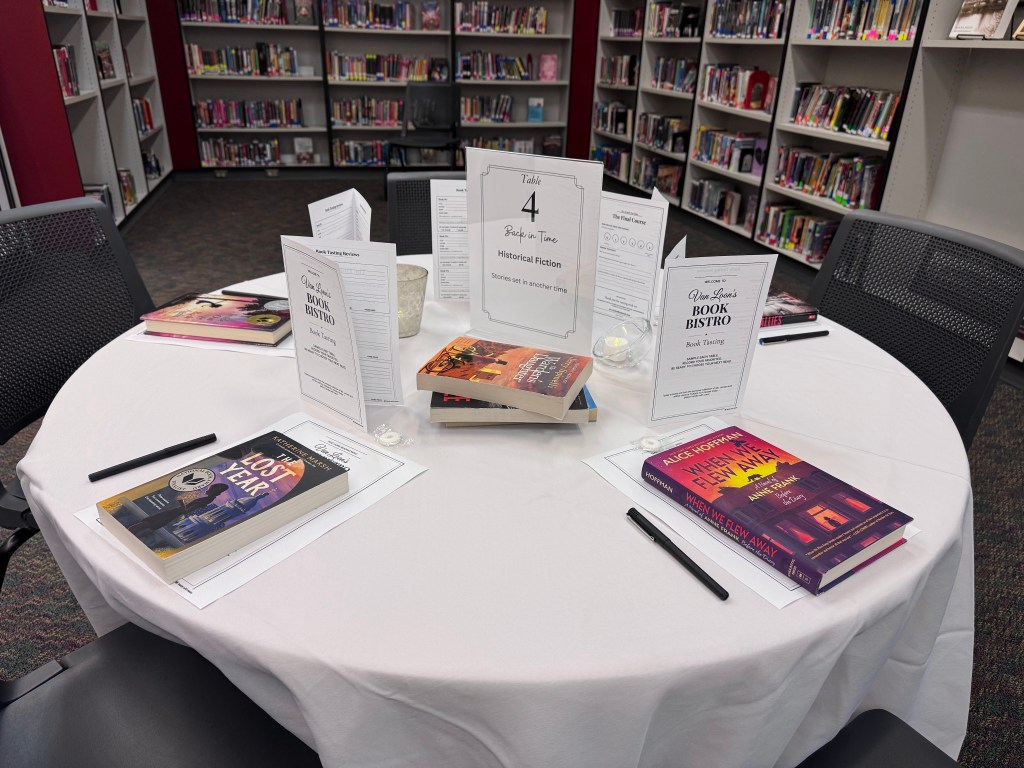
- Historical Fiction
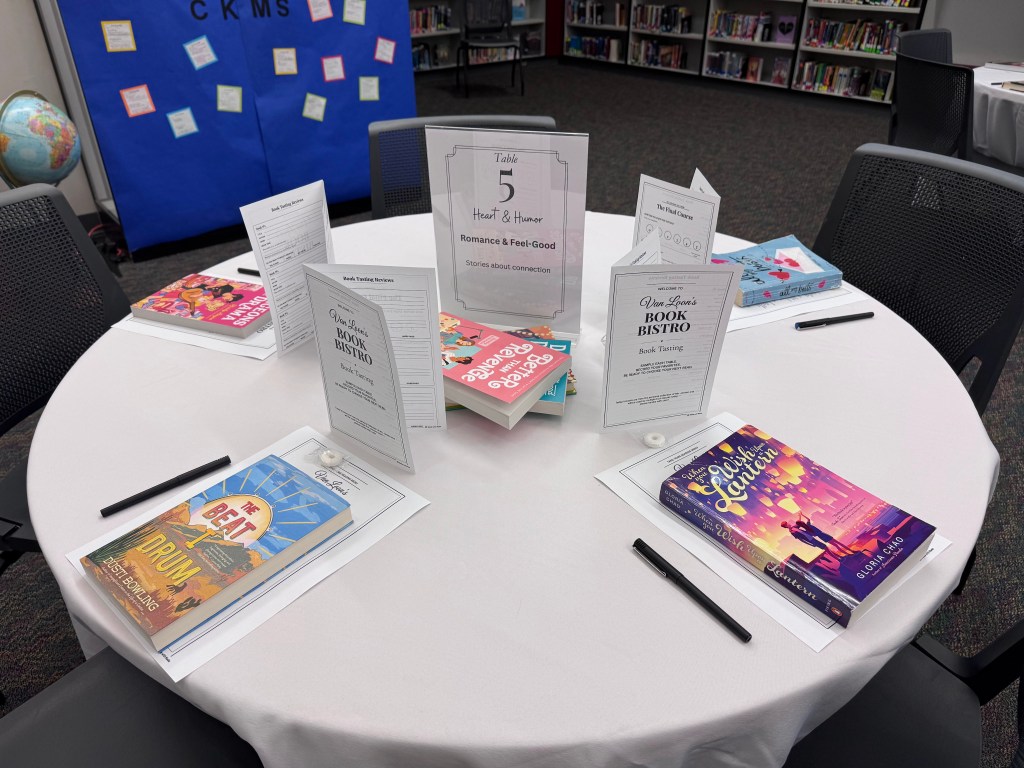
- Romance & Feel-Good
- Adventure & Mystery
The full list of 48 books is on the last page of the menu PDF included below.
Before the Tasting
To build anticipation, I created a short announcement for the teacher to share with her students the day before the tasting.
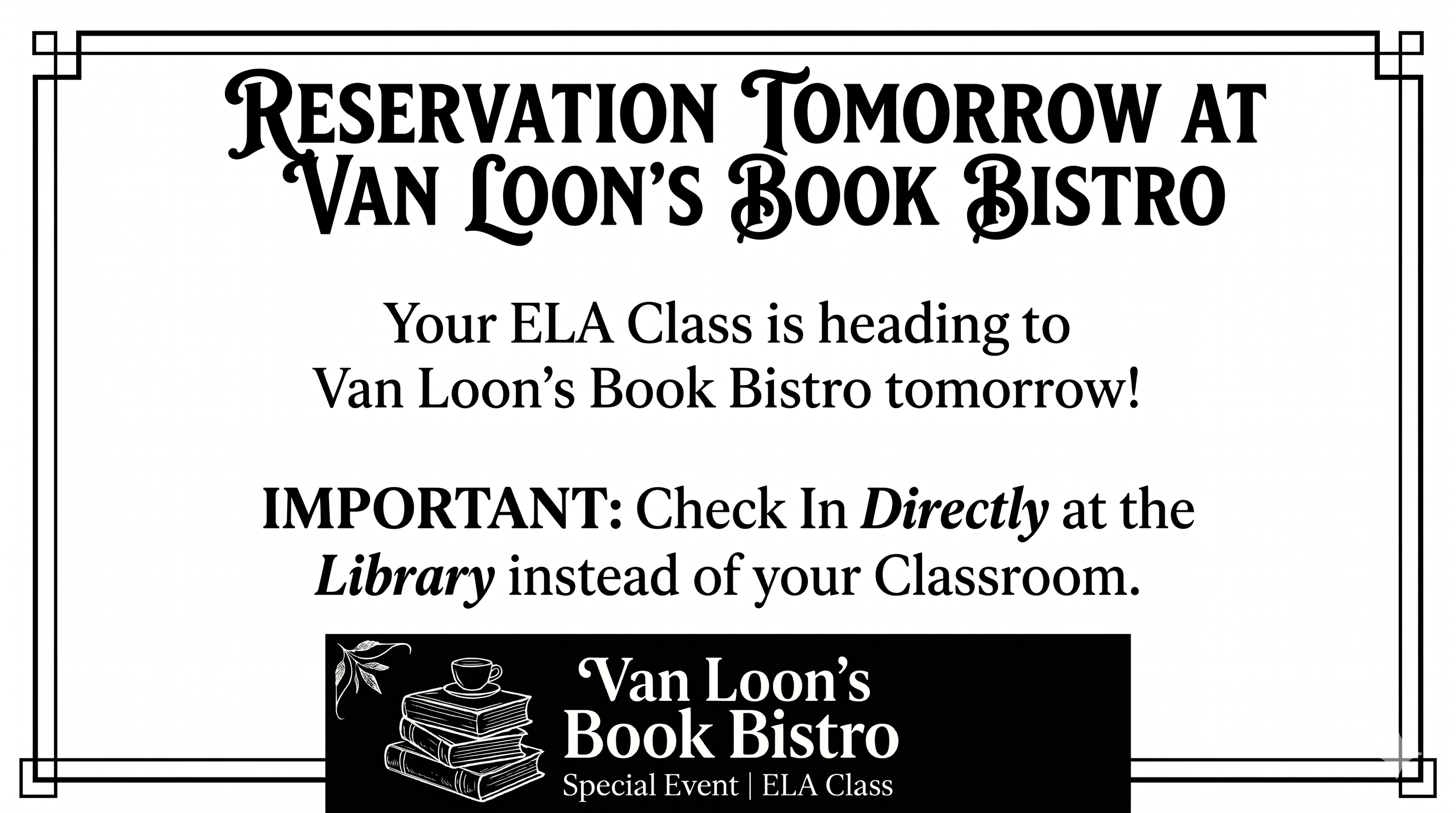
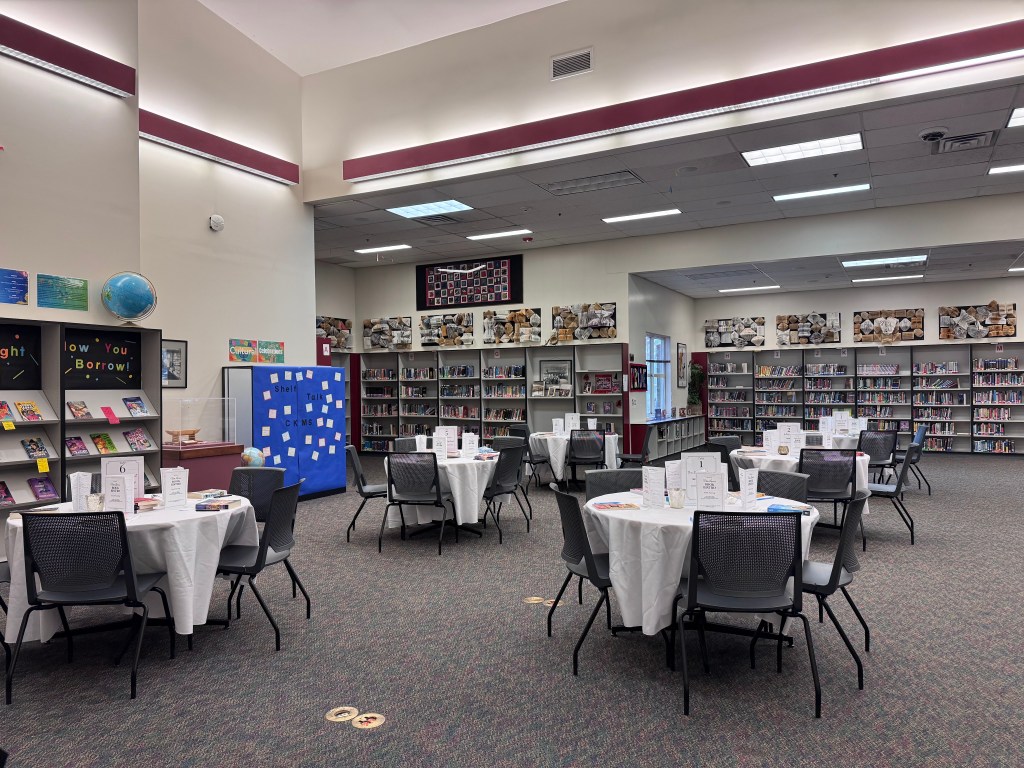
And — per my amazing, librarian mother-in-law’s suggestion — we arranged to host the tasting in the school library instead of a classroom. I highly recommend doing the same. It gave us access to round tables and enough space for students (and me) to move easily between them.
On Tasting Day
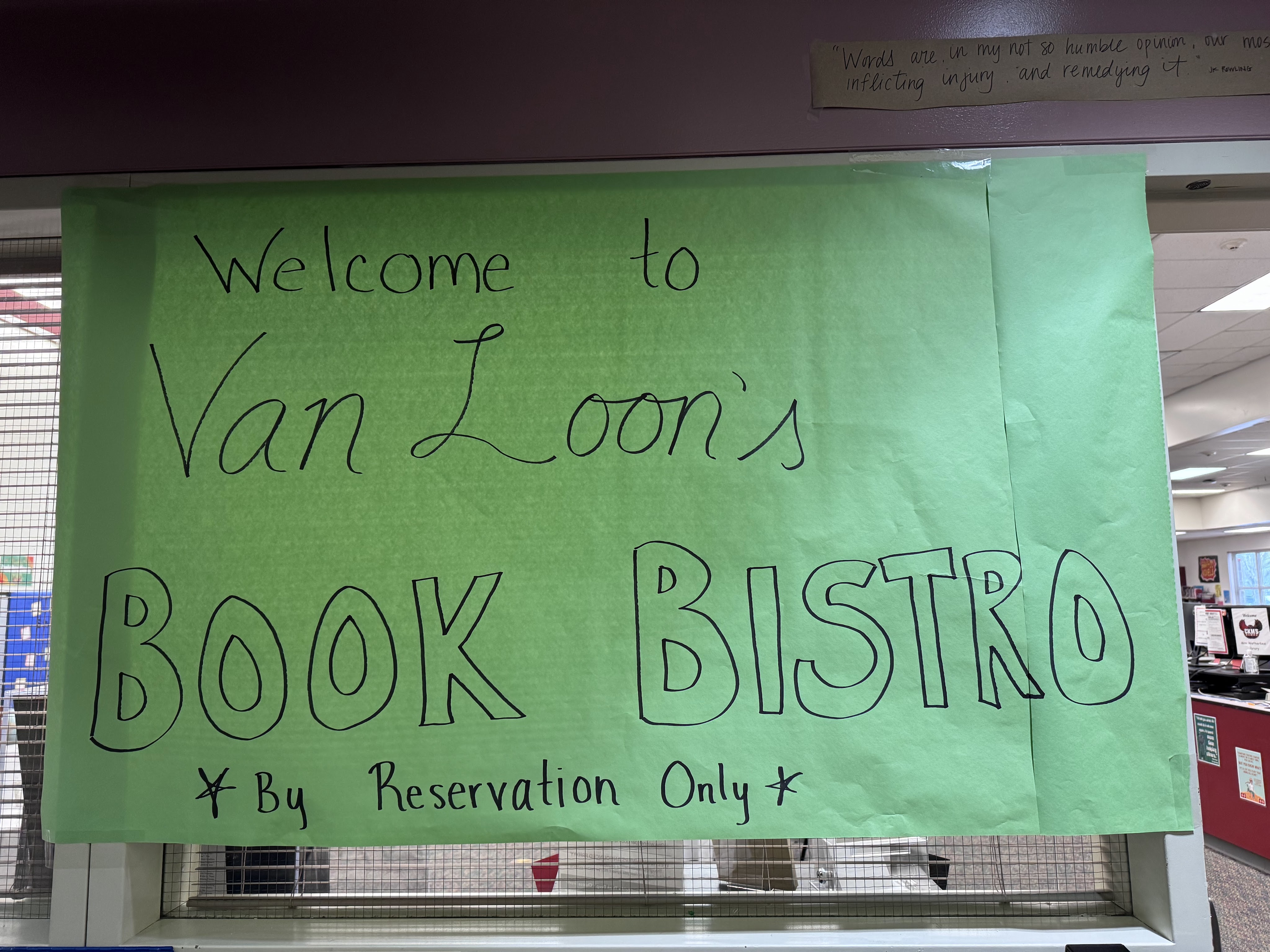
To set the scene, I added a simple sign outside the library announcing the “Book Bistro.” Bonus: this also resulted in more than a few people poking their heads into the library to check out what was going on.
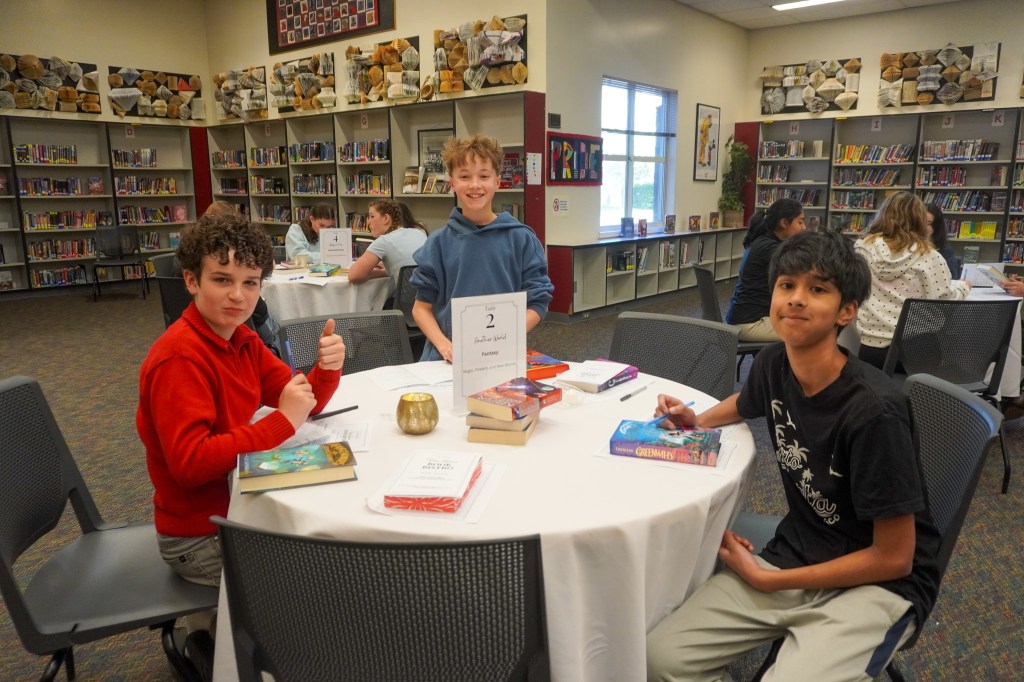
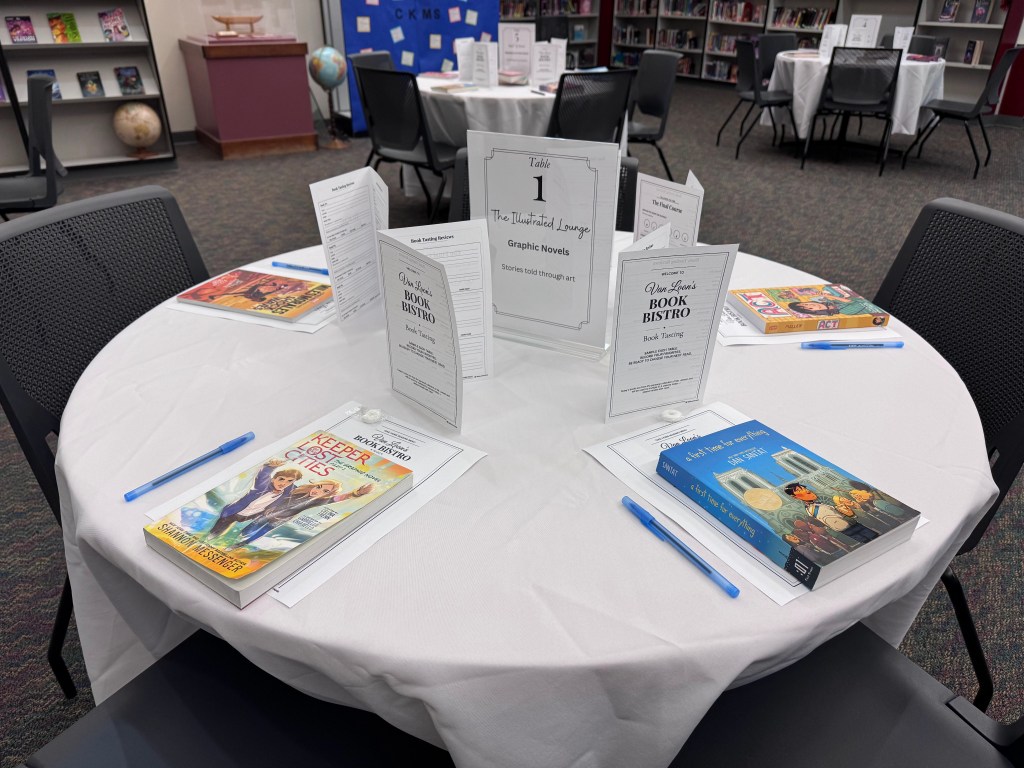
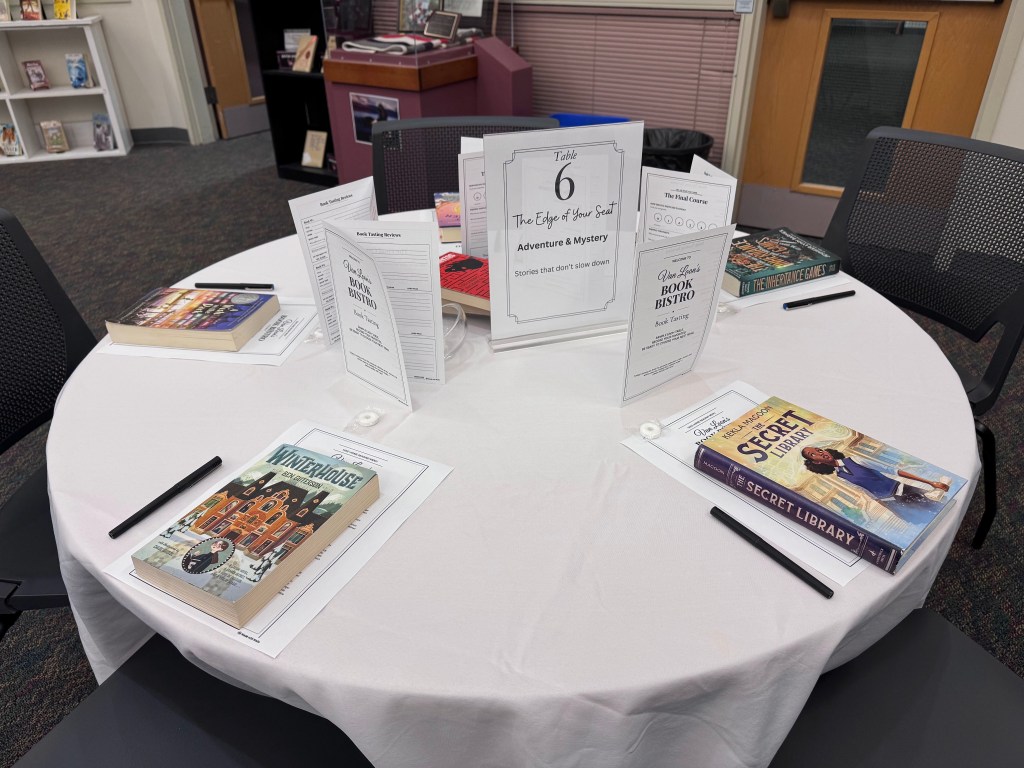
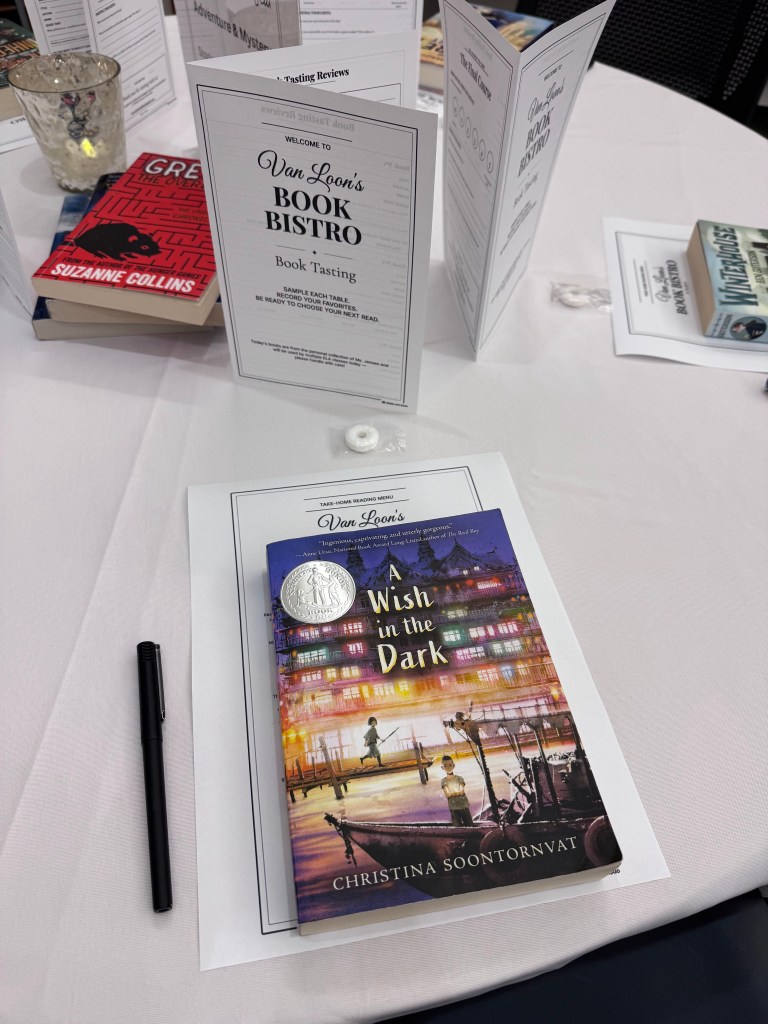
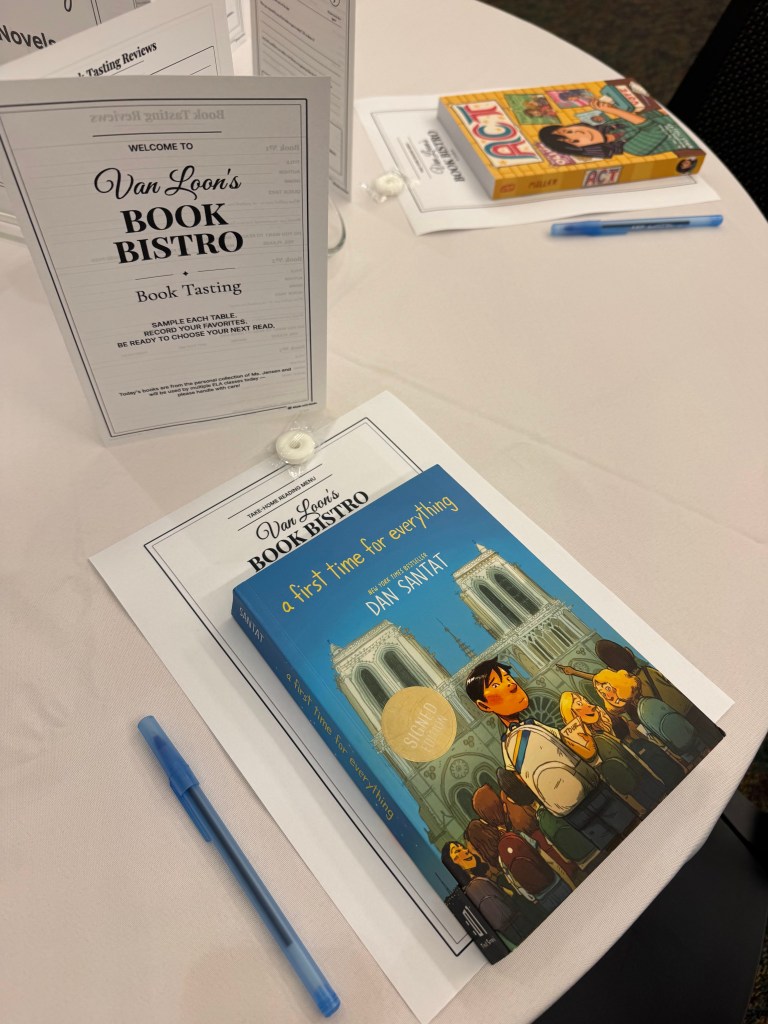
To create a restaurant feel, I set six tables with white tablecloths, table numbers in acrylic holders, and glass candleholders with battery-operated candles (more on those later . . . ). At each place setting, students had a “to-go” menu listing all the books at the tasting, a book, a menu, a pen, and (for the first round) a mint (a Dove chocolate during the sixth “dessert” rotation was also a big hit).
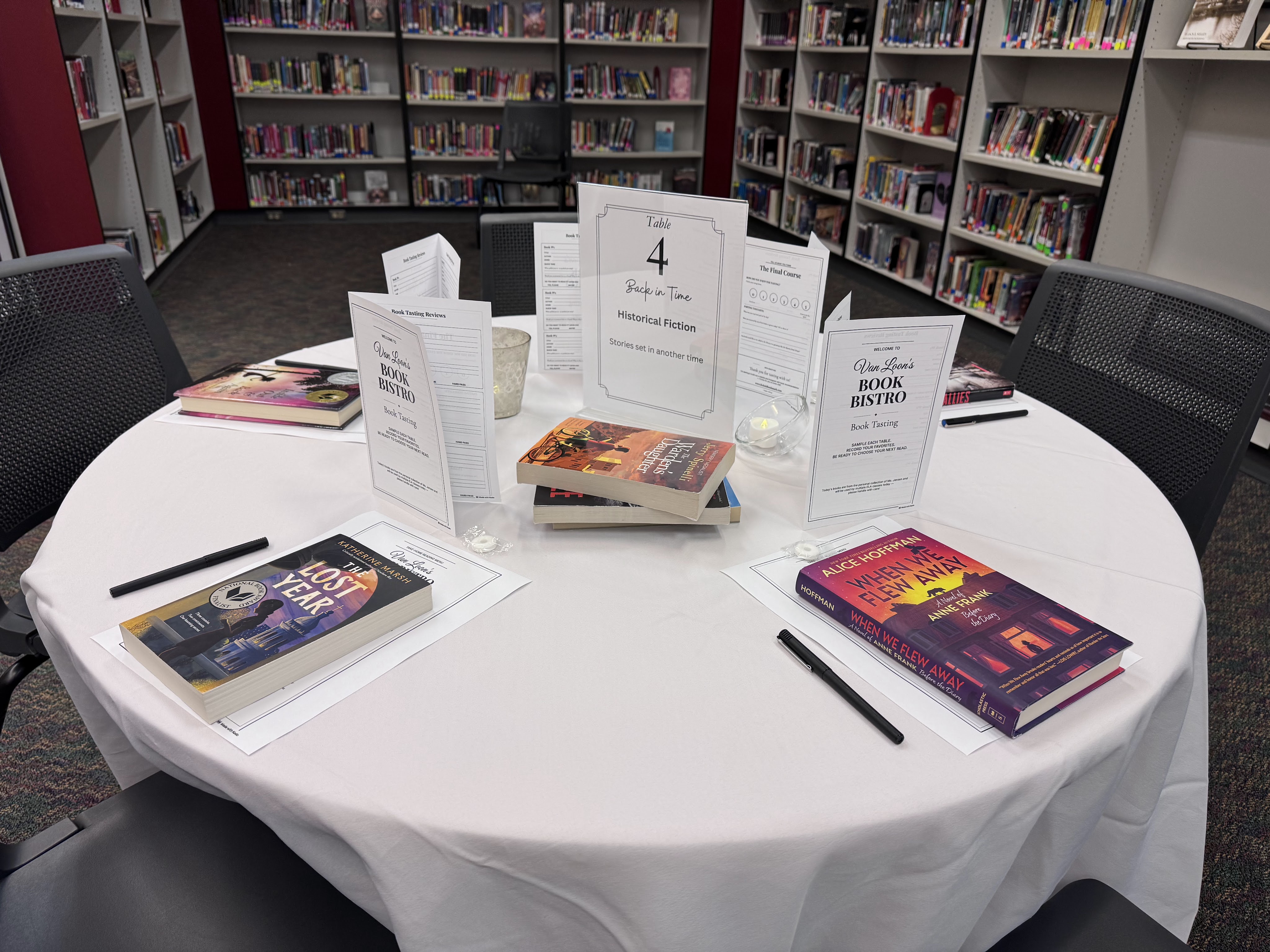
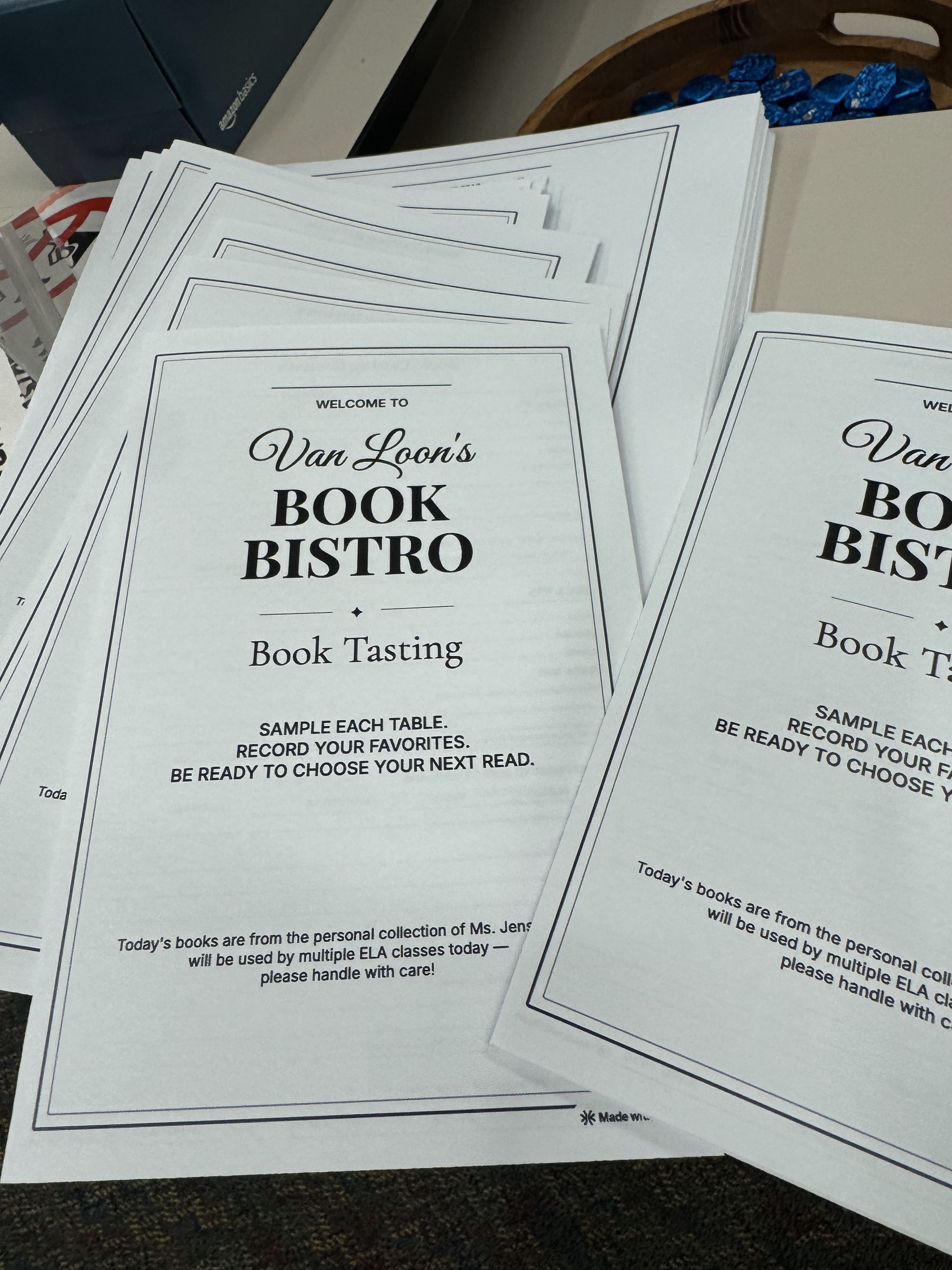
When students arrived, we briefly explained the tasting process and assigned them to their tables (Mrs. Van Loon kindly determined groups beforehand).
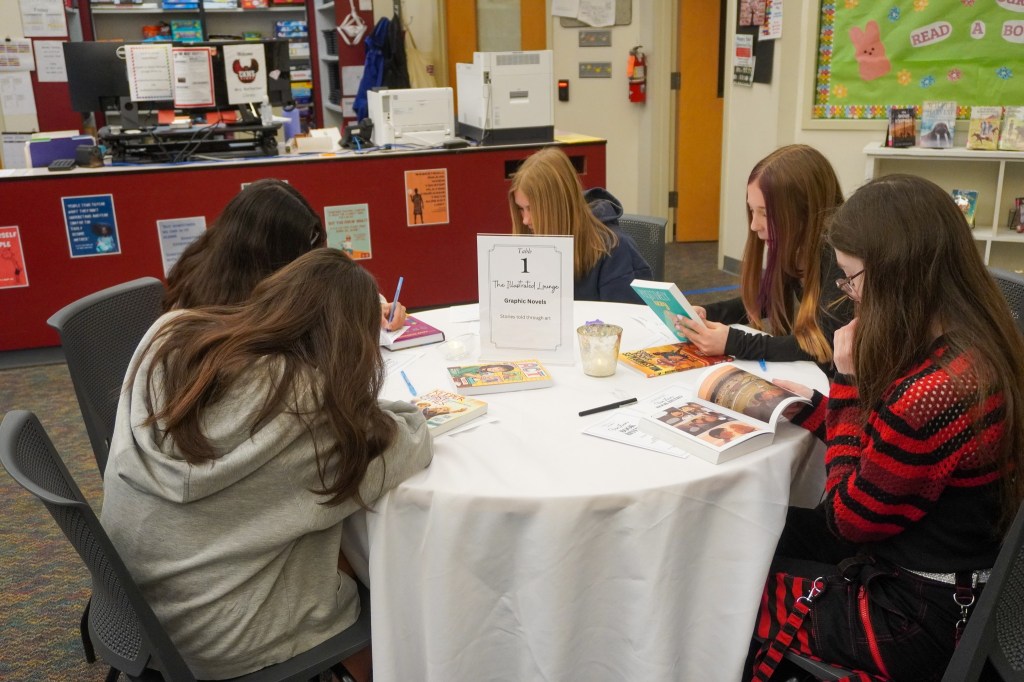
I encouraged students to check out the cover of the book at their place setting, read the blurb that would either be on the back (for paperbacks) or on the inside dust jacket (for hard covers), then spend a few minutes flipping through the book or reading the first few pages.
After about five minutes, we rotated tables so each student had time to “taste” all six genres.
Inside their menus, students could record the title, author, and genre of each book they sampled, whether they wanted to read the book (rating each as “Yes, Please,” “Maybe,” “Not for Me,” or “Hard Pass”), and what pulled them in or pushed them away from the book.
My favorite part of the day was walking around and talking with students — hearing what surprised them, what they usually read, and helping them connect with books (those on the tables or others they may like based on their preferences) in real time.
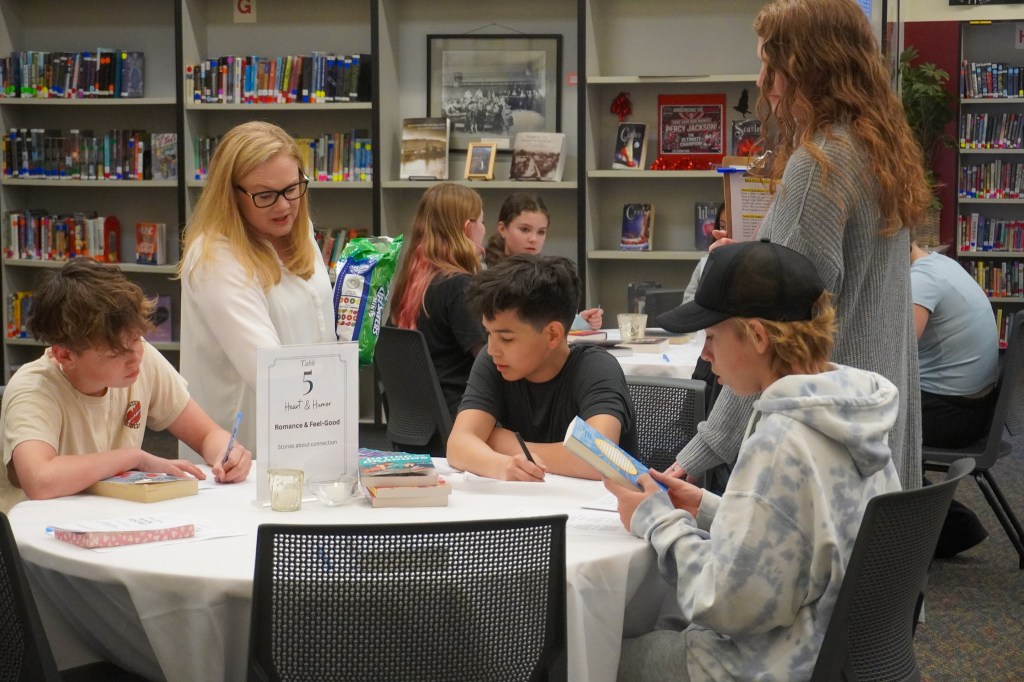
Once the tasting ended, I realized I had inadvertently created something else: a surprisingly useful snapshot of how middle schoolers actually respond to books when given the freedom to explore them.
What Students Liked (and Didn’t)
I encouraged students to take the “to-go” menu with the full book listings home with them, but I collected the menus at the end of each class. Without being in a classroom everyday, collecting data directly from students can be tough. Wanting to make the most of this opportunity, I took the 110 menus that were turned in home and captured the students’ ratings and feedback in an Excel sheet.
Here’s what stood out:
Students Want High-Stakes Page-Turners
Whether mystery (The Inheritance Games), emotional realism (Restart), or survival stories (Refugee, Allies), students consistently gravitated toward books with momentum, tension, and meaningful stakes. Nearly one-third of all “top book” mentions were one of these four books (of the 85 top-book mentions, Inheritance Games and Restart were each listed 8 times, and Allies and Refugee were listed 6 and 5 times, respectively).
Familiar Authors Drive Immediate Buy-In
Alan Gratz (Allies and Refugee) and Gordon Korman (Restart) were clear standouts, especially with middle school boys. Several boys noted they “only read” Gratz (one noted in their menu “I love the author”). I gently encouraged these students to try Gratz’s Ban This Book to broaden their genre exposure, and here’s hoping they do so, because it’s a fantastic book that is very different from Gratz’s historical fiction/survival stories.
The incredible Kelly Yang is also clearly a well-known entity with this age group. One student voted Finally Heard as a “Yes, Please” noting it was from “the same author as Front Desk” and that she “was pulled in because I liked her other book.” Another listed Chef’s Secret as a “Yes, Please” noting “I read Front Desk and this is part of it.” Yet another noted that she “really liked” Front Desk and “would read it in my free time.”
With all three of these authors consistently releasing new books, if you’ve got a reluctant middle school reader, consider keeping an eye out for new releases by these authors.
Decorative Details Attract Eyes
Students definitely gravitated towards books with:
- Fore-edge painting
- Detailed maps
- Visually interesting interiors
Even when these books weren’t at their seat, many students reached for them at some point before leaving the table. And I was surprised that multiple times I saw map pages being passed around and discussed.
Historical Fiction Resonates
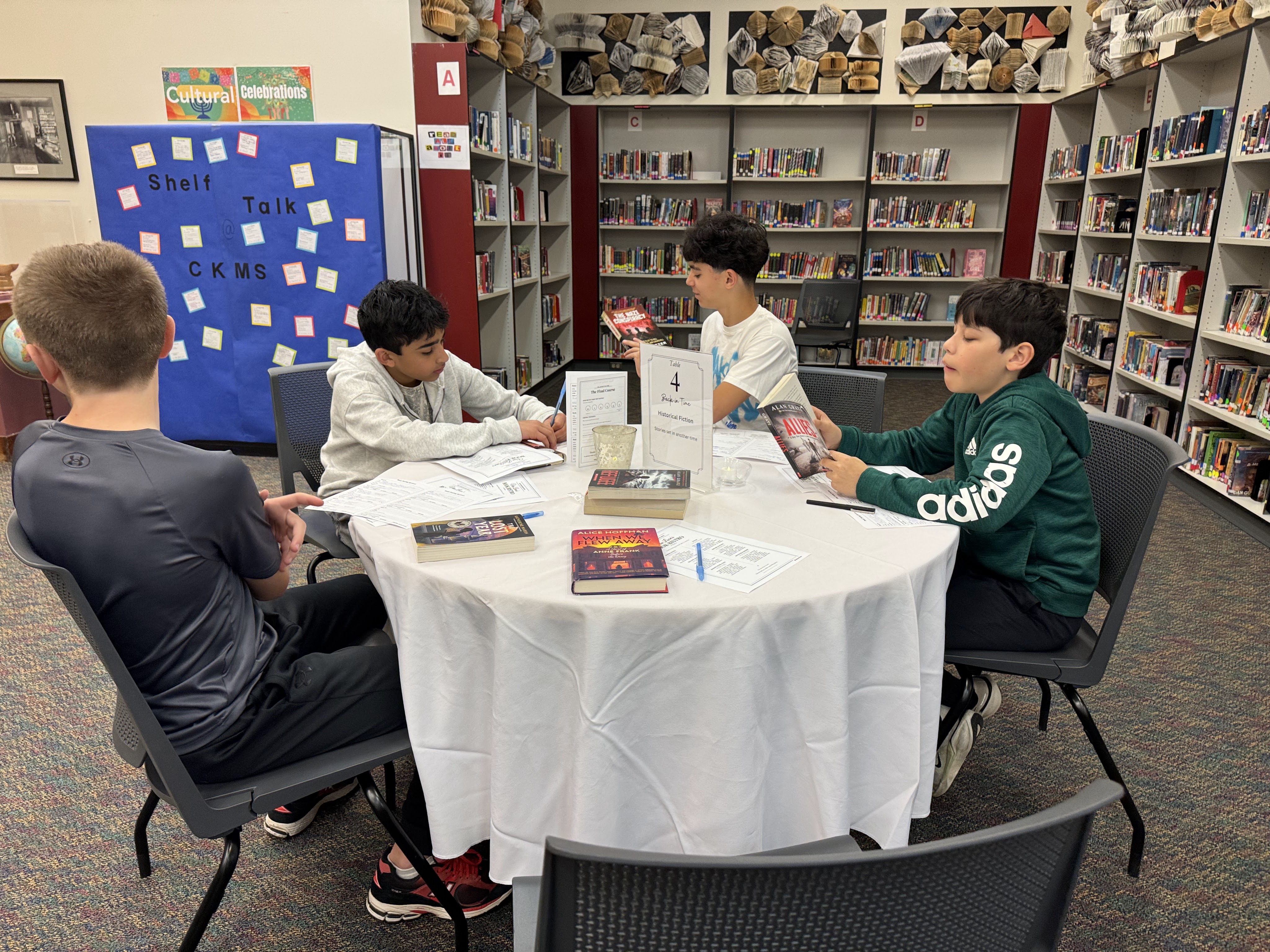
Beyond the boost from Gratz, historical fiction as a whole generated some of the strongest engagement of the entire event, tying adventure/mystery for the highest number of total top-book mentions overall (18). In addition to Allies (6) and Refugee (5), The Nazi Conspiracy (5) and The Lost Year (4) were fan favorites.
Graphic Novels Drive Engagement
Graphic novels generated about 15% of all top-book responses across multiple titles, and several students simply wrote “graphic novels” as their favorite category rather than naming a single book.
Feel-Good Books Matter Too
Feel-Good and Romance titles accounted for about 14% of top-book responses. The best performers centered on friendship, humor, awkwardness, and crushes.
Fantasy Interest is Broad
Fantasy enthusiasm spread across a wide range of books rather than one dominant favorite, including Skandar, Keeper of the Lost Cities, The School for Good and Evil, Greenwild, and Impossible Creatures.
Students Were Often Surprised by What They Liked
One of the most fruitful menu prompts asked whether students were surprised by anything at the tasting. It revealed one of the most interesting patterns in the feedback: many students came in expecting not to enjoy the tasting or assuming they already knew exactly what kinds of books they liked . . . and ended up surprising themselves.
Several students simply seemed surprised by how many books appealed to them:
- “Surprised to see lots of good books”
- “Yes, because I recognized some”
- “It surprised me with a bunch of good books”
The biggest surprises, though, often involved genres students assumed they wouldn’t enjoy:
Historical fiction, in particular, won over quite a few students:
- “Historical fiction was actually good”
- “I surprisingly found historical fiction was cool and interesting”
- “I liked the war books”
- “Yes, the historical books were really good”
A similar pattern showed up across each of the other five genres:
- “Yes, romance was so good”
- “Realistic it was fun and relatable”
- “I liked the graphic novels”
- “I liked adventure and mystery as well as realistic fiction”
- “Fantasy is usually hard for me to find a good book from” – after naming two different fantasy books as “top books” and another as “Yes, Please”
- “I didn’t really think I’d like adventure or mystery” – after naming a mystery book as “top book,” a book that should be added to library or mystery book drops, and “Yes, Please”
Now, not all feedback was glowing. But honestly, even it was useful:
- “I didn’t like most of them especially the romance books because they all have the same plot; they have to be unique” – I’ll definitely think of this student if I come across a non-tropish romance book!
- “No, I kinda knew what I liked from the start” – totally fair, and I loved that this student still rated the experience a 4 and found one “Yes, Please” book
- “Didn’t expect there to be so many realistic fiction-esque books. I would’ve appreciated a sci-fi table or something” – done and done for next time!
- Wanted “some more time to look at the books” – good to consider next time
- “I only liked the candy” and elsewhere “candy was good” – this one admittedly made me giggle. Plus, he rated the experience a 4, which feels like a pretty solid return on investment for a single mint and Dove chocolate! 😉
Most Students Found a Book that Resonated
Roughly 74% of students identified a top book they wanted to read after the tasting — a pretty strong result for a required classroom activity involving every student in five separate middle school ELA classes!
Personalized Recs Move the Needle
Here’s my biggest take away:
Putting great books in front of students is powerful. Pairing that with even brief, personalized recommendations is what really moves the needle.
I saw this play out over and over again.
There was one student I knew from earlier in the year — a big Eragon fan. At the book fair, he’d asked if we had Murtagh. We didn’t. That night, I ordered a copy, wrapped it as a mystery book, and later gave it to him.
His reaction — “For me? I can keep it?!” — is one of those moments that stick with you. A couple days later, I saw him carrying it around school and he mentioned he was already several hundred pages in. Yeah . . . that’s why I do this.
So when I came across Skandar, I immediately thought of him. I made sure it was on the table. And when he rotated into fantasy, I pointed him to it.
He spent the entire table session reading it — and tried to carry it with him to the next table. :). That’s the difference a small, intentional connection can make.
Even with students I didn’t know, the same pattern held. A quick conversation — “What do you usually like?” followed by some version of “Ohhh, have you tried [insert book with that connective tissue]” — was often enough to shift their openness to a book. It reinforced something I’ve seen again and again:
Many kids don’t dislike reading.
They just haven’t found the right book yet.
And sometimes they haven’t found the right format, genre, or entry point yet either.
If you’re a parent or educator: any chance you have to personalize a book recommendation — even briefly — is a chance worth taking.
Personalized recommendations lower the barrier to entry and make books feel less like assignments and more like discoveries. It can be the difference between a student rejecting a book . . . and a student carrying one around all day because they can’t put it down.
Whole-Class Participation is . . . Different
Up until now, most of my work has been with self-selected readers (book fair shoppers, mystery book entrants, one-off conversations when students come into the library, etc.).
This was not that. It was a required middle school class period in which all students were expected to participate.
There were students in every class who had very little interest in reading and a lot of interest in entertaining themselves (and everyone else) in their own ways. I learned that some middle school boys, in particular, can be . . . a lot. ;). Which means, at various points:
- Battery-operated candles were launched across the room
- Pens became mini basketballs aimed at glass candleholders
- One tablecloth did not survive (RIP)
That said, when I connected with those same kids one-on-one, many of them did engage. They joked, they shared opinions, and some even found books they rated “Yes, Please.” Surprisingly, many of these boys rated the tasting experience a 4 or 5 (out of 5), and most of them listed a top book.
I’m going to focus on that as a win that’s well worth the cost of a tablecloth. 😉
Next Steps
One of the most rewarding parts of the day wasn’t just seeing which books were popular — it was noticing who lit up about specific books. There were a handful of students who lingered with a book when it was time to rotate, one who asked if they could buy a specific book off me at that moment, a couple who brought a book from one table to the next, and many who made notes in their menu like: “NEED to read Dungeons & Drama,” “for sure read this!” and “Definitely read.”
Their actions and words made it clear: they saw something they wanted.
So my next step is simple: I’ve purchased several of the books these highly engaged students were most excited about. I’m going to wrap and decorate them so they feel special, then gift them to those students in addition to donating several of the top books to Mrs. Van Loon’s classroom library.
Because when a student finds a book they actually want to read, it’s a moment that matters. And it’s a moment that’s worth reinforcing.


Leave a Reply